
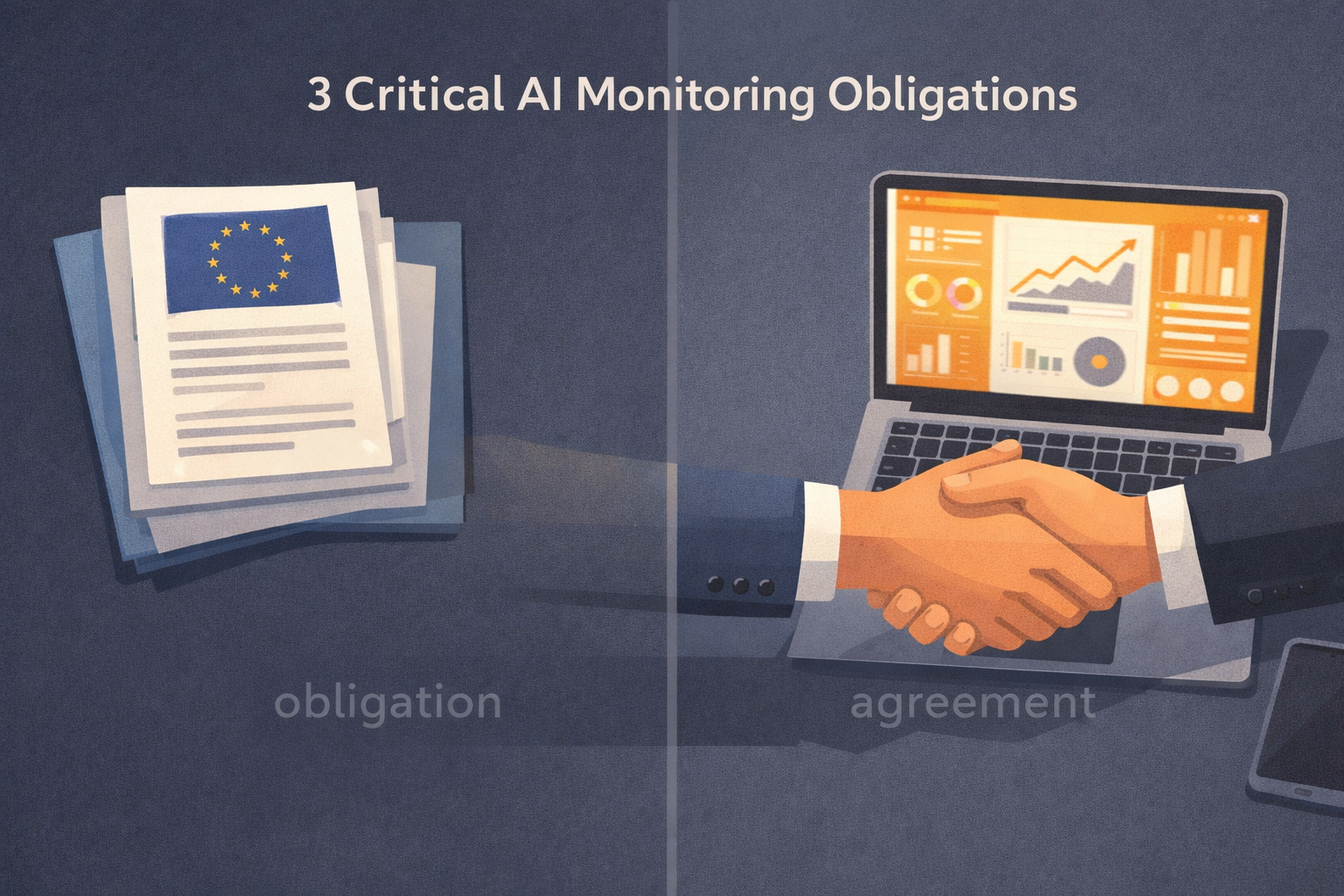
3 Critical AI Monitoring Obligations
A government just negotiated direct access to a frontier AI company's operational data; not through regulation, but through a handshake. The Anthropic-Australia MoU, signed on 1 April 2026, commits Anthropic to sharing economic impact data, participating in joint safety evaluations and collaborating with Australia's AI Safety Institute. For AIGP candidates, AI post-market monitoring just stopped being a textbook concept and became a live governance question.
What the Anthropic-Australia MoU Actually Contains
The MoU is non-binding. That matters. It sits outside any legislative framework, yet it creates operational expectations that mirror what the EU AI Act imposes through law. Anthropic agreed to share its Economic Index data with the Australian government; this tracks how Claude is being used across sectors, what tasks it performs and what the workforce implications might be. The company will also participate in joint safety evaluations with Australia's AI Safety Institute, sharing findings on emerging model capabilities and risks.
This is not a compliance obligation. It is a voluntary arrangement. But the governance infrastructure it requires; logging, metrics pipelines, incident-sharing protocols, sector-level usage tracking; is indistinguishable from what a regulated provider would need to build.
How This Compares with EU AI Act Article 72
The EU AI Act takes a different route to the same destination. Article 72 requires providers of high-risk AI systems to establish and document a post-market monitoring system that actively collects, documents and analyses performance data throughout the system's lifetime. The monitoring plan must be part of the provider's technical documentation.
The difference is compulsion. Under the AI Act, AI post-market monitoring is a legal requirement with enforcement consequences. Under the Australian MoU, it is a political commitment with reputational consequences. For the AIGP exam, that distinction matters. The IAPP's Body of Knowledge (BoK) for the AIGP certification, the document that defines every domain and topic candidates are tested on, covers both angles. Domain III.C.4 expects candidates to understand how to manage and document incidents, issues and risks. Domain III.C.6 covers public disclosures to meet transparency obligations. A scenario question could test whether you recognise the difference between a regulatory monitoring obligation and a voluntary data-sharing commitment; and what governance controls apply to each.
AI Post-Market Monitoring in Practice
Strip away the politics and the exam question underneath is operational: if your regulator (or your government, or your largest customer) asked tomorrow for usage telemetry, workforce impact data and safety evaluation access, could you provide it?
That question breaks into three parts.
Logging and Metrics Pipelines
You need to know what your AI system is doing. Usage data by sector, task type and user segment. Performance data over time. Incident records. None of this is optional under the EU AI Act for high-risk systems, and the Australian MoU suggests governments will increasingly expect it from general-purpose AI providers as well. Domain III.C.3 of the AIGP BoK covers the periodic activities required to assess performance, reliability and safety; audits, red-teaming, threat modelling and security testing all sit here.
The Transparency and Trade Secret Tension
Sharing operational data with a government body creates an obvious conflict. The more detailed your monitoring data, the more it reveals about model architecture, training approaches and commercial strategy. The EU AI Act acknowledges this; Article 78 requires market surveillance authorities to protect confidentiality and trade secrets. But the AIGP exam expects candidates to understand that transparency obligations (III.C.6) and intellectual property protections are not binary. Governance professionals must scope disclosures to satisfy the obligation without exposing competitive intelligence. That scoping exercise is itself a governance task.
Joint Safety Evaluations
The MoU includes joint evaluations with Australia's AI Safety Institute. Anthropic has similar arrangements with safety institutes in the US, UK and Japan. For governance professionals, these engagements resemble external audits: they require controlled access to systems, pre-agreed evaluation protocols and documentation of findings. The exam tests whether candidates understand who manages these engagements, what access controls apply, what documentation is produced and who owns the results. That is Domain III.C.3 territory, and increasingly Domain I.B.1; defining roles and responsibilities for AI governance stakeholders now includes managing relationships with external safety evaluators.
Why AI Post-Market Monitoring Matters for Your Exam
The Anthropic-Australia MoU is not on the AIGP syllabus. But AI post-market monitoring, transparency obligations and incident documentation are. The MoU simply makes them concrete. When you encounter a scenario question about a government requesting operational data from an AI provider, the analysis runs through III.C.3, III.C.4 and III.C.6. The candidate who can distinguish a legal obligation from a voluntary commitment; and explain what governance controls apply to each; is the candidate who passes.
For a structured approach to practising AIGP exam scenarios, the free assessment at 22academy.com gives you a baseline and a place to start.