Certifications AIGP CIPP/E CIPP/US CIPM CIPT All certifications Career plan How it works Pricing Log in Start free
Study guide

The complete CIPP/E study guide

What the exam asks, in what order to study it, how long it takes, what it costs and where candidates lose marks.

AI-generated image - a professional with a folder outside a European institution, for the CIPP/E study guide
What it is

What is the CIPP/E?

The CIPP/E, the Certified Information Privacy Professional/Europe, is the certification for European data protection law. It tests whether you can apply the GDPR, the ePrivacy rules and the decisions of the regulators and courts to real situations, not only whether you can recite them.

It is issued by the IAPP and accredited under ISO/IEC 17024. There are no prerequisites: no degree and no minimum experience. You sit it online or at a test centre, in English, French or German.

Format and fees

90questions75 scored, 15 unscored
150minutesoptional 15-minute break
300of 500 to passscaled score
$550exam feeretake $375
12monthsto sit after you buy
20CPE creditsevery two years, plus the fee

Membership of the IAPP costs $295 a year and includes the maintenance fee; without membership that fee is $250 every two years.

Before you plan anything, find out what you already know. Free account, fifteen minutes.Free CIPP/E assessment
The body of knowledge

The five domains, and what each one asks

The IAPP publishes a body of knowledge for each certification: the list of competencies the exam is written from, with the minimum and maximum number of questions per domain. The current version for CIPP/E is 1.3.3, in force since 1 September 2025. The 22Academy course follows it concept by concept.

1

Introduction to European data protection

7 to 13scored questions

Where the rules come from: the institutions, the history from Convention 108 to the Charter, and which instrument does what. The legislative framework now names the EU AI Act and NIS2 alongside the GDPR and the ePrivacy Directive.

Where people lose marks

The institutions. The Council of the EU, the European Council and the Council of Europe are three different bodies, and the exam asks about all three.

From the 22Academy bank · definition

Which body is made up of the heads of state or government of the EU member states, together with its President and the President of the Commission?

Twenty more like it, free
2

European data protection law and regulation

18 to 28scored questions

The core of the GDPR: who is a controller or a processor, what counts as personal data, how security and breach notification work, and every right with its conditions, exceptions and deadlines. The largest domain on the exam.

Where people lose marks

The rights. Knowing that a right exists is not the same as knowing its conditions, its exceptions and its deadline.

From the 22Academy bank · two-statement true or false

Statement I: a data subject can always have their personal data erased on request. Statement II: a controller must normally answer a data subject request within one month of receiving it. Which statement is correct?

Twenty more like it, free
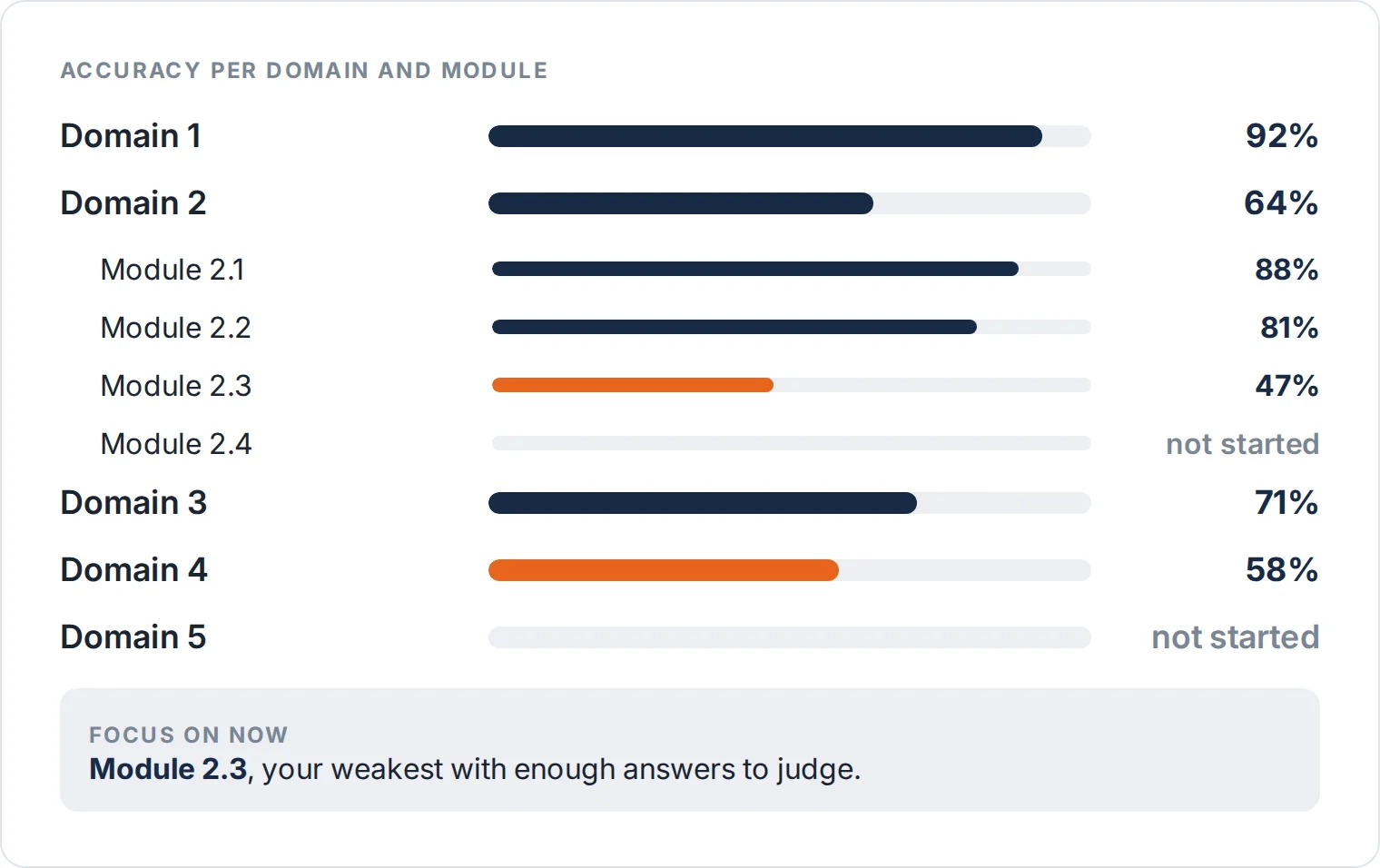
Screenshot of the 22Academy course - accuracy per domain and module, with the weakest module marked as the one to focus on now
Screenshot from results in the course
Domain by domain

Domain 2 is where the marks are. Is it where yours are?

Up to 28 of the 75 scored questions come from domain 2. The course shows your accuracy per domain and per module, and points at the module to work on now.

3

European data processing

13 to 21scored questions

How processing becomes lawful: the principles, the six lawful bases, consent and legitimate interest, transparency, and the rules for sending personal data outside the EEA.

Where people lose marks

Transfers. Candidates reach for standard contractual clauses without checking for an adequacy decision first, and treat Article 49 as an alternative rather than a last resort.

From the 22Academy bank · scenario

A retailer in the Netherlands wants to move its customer support to a provider in a country without an adequacy decision. What should it rely on before it considers a derogation under Article 49?

Twenty more like it, free
4

Scope and accountability

8 to 18scored questions

Who the GDPR reaches and how compliance is shown and enforced: territorial scope, accountability, records, DPIAs, the DPO, the supervisory authorities, the one-stop shop and fines.

Where people lose marks

When a DPIA is mandatory, and who decides. The answer is the test in Article 35 plus the national list, not a feeling about risk.

From the 22Academy bank · best answer

A bank plans to decide on loan applications automatically, using data combined from several sources. What is the BEST reason it must carry out a DPIA first?

Twenty more like it, free
5

Compliance

8 to 16scored questions

The GDPR applied to everyday practice: employment, surveillance, direct marketing and cookies, and new technology, including AI.

Where people lose marks

Consent at work. It is rarely valid in an employment relationship, and the exam offers it again and again as the plausible wrong answer.

From the 22Academy bank · judgement

An employer wants to monitor staff email to detect data leaks. Which lawful basis is MOST likely to be valid?

Twenty more like it, free

Not using your IAPP membership? Pay only the $250 maintenance fee and keep $340 every two years.

Start CIPP/E free
The rules

The articles

Four clusters of articles run through the whole exam. Know these well and the scenario questions become readable.

Principles

Articles 5, 6, 7 and 9

The six lawful bases, the balancing test for legitimate interest, and when consent fails.

Transparency and rights

Articles 12 to 22

Each right with its conditions, its exceptions and the one-month clock, extendable by two months.

Accountability

Articles 24 to 43

Records, security, breach notification within 72 hours, DPIAs, the DPO and the supervisory authority.

Transfers

Articles 44 to 49

Adequacy first, then appropriate safeguards, then derogations. Schrems II and supplementary measures.

Worth knowing

The guidelines

The body of knowledge names guidelines of the European Data Protection Board per domain, and they are examinable. Knowing what each one decides matters more than memorising paragraphs; check the current list in the body of knowledge.

Controllers and processors

Who decides purposes and means, and when two parties are joint controllers.

Territorial scope

When the GDPR reaches an organisation outside the EU.

Right of access

What a copy must contain, and when a request is manifestly unfounded or excessive.

Consent

What valid consent requires, and when it cannot be freely given.

Transparency

What Articles 12 to 14 require you to tell people, and how.

Data breach notification

When to notify the authority, and when to tell the people affected.

Article 49 derogations

Why derogations are a last resort, not an alternative to safeguards.

Supplementary measures

The steps for a transfer after Schrems II.

Lead supervisory authority

How the one-stop shop is applied.

Video devices

Lawful basis, signs, retention and access for camera surveillance.

Targeting of social media users

Who is responsible for targeting, and on what basis.

Right to be forgotten in search engines

How delisting works against search results.

Decisions

Case law

The exam tests application, and these judgments are where application was settled.

Schrems I, 2015

Struck down Safe Harbor: a transfer mechanism must give protection essentially equivalent to the EU's.

Schrems II, 2020

Struck down the Privacy Shield; standard contractual clauses survive, with a duty to assess the destination and add measures where needed.

Google Spain, 2014

The right to be delisted from search results, and a search engine is a controller.

Planet49, 2019

Pre-ticked boxes are not consent, and the cookie rules apply whether or not the data is personal.

Fashion ID, 2019

A website embedding a social plugin is a joint controller for the collection and transmission.

Meta v Bundeskartellamt, 2023

A competition authority may consider GDPR compliance, and consent to a dominant platform is rarely freely given.

Always current

When the rules change, your course changes with them.

Every explanation in the course is stored once and linked to its source. When a regulation, a guideline or a decision changes, we update it in one place and every lesson that uses it is correct from that moment.

AI-generated image - a hand adds a new volume to a row of law books, as the course is updated when the rules change
The questions

How the questions are built, and how to read them

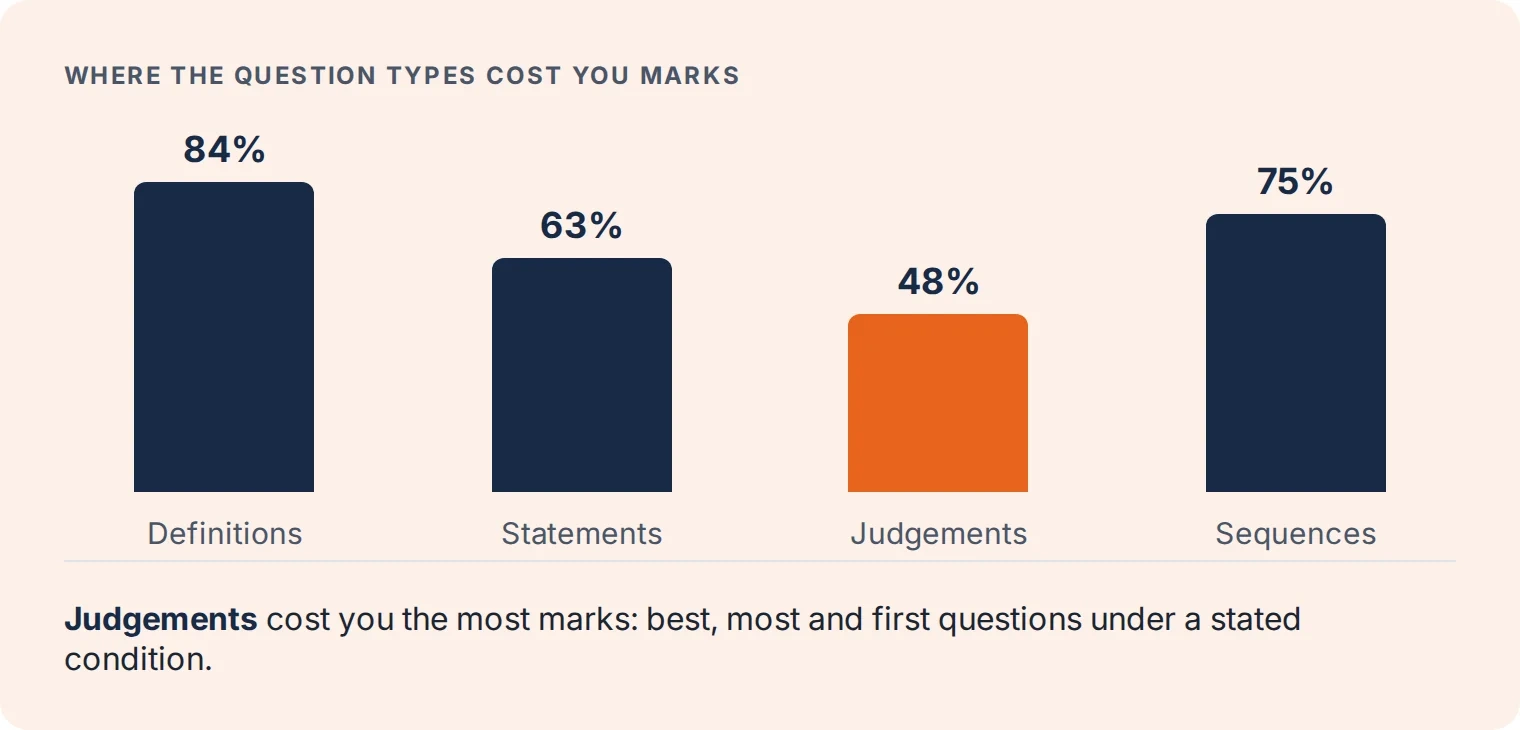
Exam questions come in a small number of structures, and a candidate who knows the content can still lose marks on the structure. The course tags every question with its structure; the technique is one tap away on each one, and every test shows whether you lost the mark on the content or on the type of question.

Two-statement true or false
Judge each statement on its own before you look at the options.
Best, most, primary
Underline the qualifier. Several options are defensible; one is the most complete.
Except, least, not
Three options are right. You are looking for the one that is wrong.
Only if, unless, provided that
Restate the rule without the condition, then test whether the outcome could happen without it.
Scenario
Read the question first, then the scenario. The scenario carries deliberate noise.
Definitions
The trap is a neighbouring term with one word changed.
Screenshot of the 22Academy course - score per question type, showing which type costs you the most marks
Screenshot from results in the course

Buy the exam voucher when you are ready, not before. It expires a year after you buy it.

Free CIPP/E assessment
How long it takes

How long does it take to prepare?

The IAPP recommends at least 30 hours of study. People who work with the GDPR every day need less; people new to data protection need more. At three hours a day you can be ready in about a month.

Book the exam before you feel ready: a fixed date concentrates the effort. You have twelve months from purchase to sit it.

CIPP/E course€37 a week

Or €117 a month with a trial exam included.

Start the course

A four-week plan, at three hours a day

  1. Week 1The free assessment, domain 1 and the concepts of domain 221 h
  2. Week 2Domains 2 and 3: security, breach notification, the rights, the principles and the lawful bases. First module tests21 h
  3. Week 3Domains 3 to 5: transfers, accountability, DPIAs, the DPO, supervision, employment and marketing21 h
  4. Week 4Question structures, the trial exam and its analysis, work on the weak modules, then book the exam21 h

A guideline. The course builds your own plan from your assessment and the hours you have.

Resources

Resources, and what each one is worth

ResourcePriceWorth it?
CIPP/E body of knowledgeFreeEssential. Work through it competency by competency.
The GDPR itselfFreeNo substitute. Read the articles against the recitals.
The IAPP textbookIAPP storeUseful for self-study; it can lag the current body of knowledge.
EDPB guidelinesFreeExaminable. Summaries save a great deal of time.
IAPP official trainingFrom $995A good introduction. It does not replace practice under time pressure.
IAPP practice examAbout $55One exam, useful for the house style of the questions.
22Academy CIPP/E course€37 a week or €117 a monthThe full course, the exam skills, the measurement and a trial exam. Stop when you are ready.
22Academy trial exam€42, or free with a monthly planFull length under real conditions, with analysis by domain and by question type.
Ten mistakes

Ten mistakes that cost candidates the exam

  1. Studying everything equallyDomain 2 carries up to 28 scored questions, domain 1 as few as 7.
  2. Reading the scenario firstThe scenario is written with noise in it. Read the question first.
  3. Missing the qualifierMost, best, primary and except change the logic of the whole question.
  4. Consent as the defaultIn an employment relationship it is rarely valid.
  5. Clauses before adequacyAdequacy comes first, then safeguards, and derogations last.
  6. A right without its conditionsThe deadline and the exceptions are what is tested.
  7. Confusing the three councilsA mark that should never be lost.
  8. Practice in the last week onlyTesting early is what finds the weak domains.
  9. Exam dumpsOften wrong, against the candidate agreement, and useless on scenarios.
  10. Sitting too earlyA retake costs $375. A trial exam costs €42 and tells you whether you are ready.

If you fail, fail cheap. Ten trial exams cost less than one retake.

Buy a trial exam
Jobs and pay

What jobs does CIPP/E lead to, and what do they pay?

The CIPP/E is the certification for anyone whose job depends on getting European data protection right. It opens the door to roles on the legal side, such as privacy counsel and data protection officer, and on the operational side, such as privacy manager and head of privacy. With the AIGP next to it, it leads into AI governance, the newest of these careers.

Most of these roles ask for the certification by name, because it shows an employer that you can apply the law rather than only describe it. Pay rises with the scope of the role, and at the top end these are among the better-paid jobs in compliance.

Each role page shows which certifications it takes, in which order, and how long it takes.

Which first

CIPP/E or another certification: which first?

CertificationWhat it coversTake it when
CIPP/EEuropean data protection lawYou advise on the law, or need the foundation for everything else
CIPP/USUnited States privacy law, federal and stateYou work with American data, clients or colleagues
CIPMRunning a privacy programmeYou run privacy rather than advise on it
CIPTPrivacy in technologyYou build or run the systems
AIGPAI governanceYour organisation builds or uses AI

Not sure? The career plan starts from the job you want.

Glossary

The terms the exam expects you to use precisely

Personal data
Any information relating to an identified or identifiable natural person.
Special categories
Article 9 data, such as health, biometric data, beliefs and trade union membership.
Pseudonymisation
Data that can no longer be attributed to a person without additional information kept separately.
Anonymisation
Irreversible, and outside the GDPR entirely.
Controller
Determines the purposes and means of processing.
Processor
Processes on behalf of the controller, under Article 28 terms.
Joint controllers
Determine purposes and means together, with an arrangement under Article 26.
Recipient
Anyone to whom data is disclosed, whether a third party or not.
Lawful basis
One of the six grounds in Article 6.
Legitimate interest
Needs a documented three-part balancing test.
Profiling
Automated processing to evaluate personal aspects of a person.
DPIA
Required where processing is likely to result in a high risk, Article 35.
Prior consultation
Article 36, when a DPIA shows a high residual risk.
Adequacy decision
A Commission finding that a third country protects data adequately.
Standard contractual clauses
Commission-approved contract terms for transfers.
Lead supervisory authority
The authority of the main establishment under the one-stop shop.

Know the terms. Now prove it.

Free account, fifteen minutes, your score per domain.

Exam day

Exam day, and after

Pace

About 1 minute 40 seconds a question. Flag and move on.

Eliminate first

Removing what is wrong is faster than hunting for what is right.

The qualifiers

Most, best, primary and except decide what is being asked.

The break

Optional, fifteen minutes. Taking it means submitting the first half for good.

Online or at a test centre: both work. If you sit online, do a full dry run the day before, and disconnect second screens and docking stations.

Passed? You keep the certification with 20 CPE credits in every two-year period, plus the maintenance fee or an IAPP membership that includes it.

Not this time? A retake costs $375, and your progress in the course is still there.

“After passing the mock exam from 22academy, I truly felt prepared for the real exam.”

Pedro, CIPP/E

Harder than the real thing, on purpose.

We believe a trial exam should hold a higher standard than the real one. Pass ours at the first attempt, sit the real exam within two weeks and fail it, and we refund what you paid for that trial exam.

Conditions
Questions

Questions people ask about the CIPP/E

Is the CIPP/E hard?

It is demanding rather than hard. Most of the effort goes into vocabulary and structure: knowing exactly what a controller is, which lawful basis fits, what a right requires and by when. The rest is applying those rules to a messy scenario under a clock. The questions reward precision, the qualifier in the question, the condition in the rule and the deadline in the article, so candidates who practise on exam-style questions early do far better than those who only read.

Do I need to be a lawyer?

No. There are no prerequisites, no degree and no minimum experience. Candidates come from compliance, security, IT, HR and management as well as from law. The exam tests whether you can apply the rules to a situation, not whether you can argue them in court, and the course explains every concept in plain language as well as in its legal form.

How is 22Academy different from IAPP training?

The IAPP offers traditional classroom courses and e-learning in which the content is presented to you. We start from the fact that you already have access to all the content, so we focus on getting it into your head rather than throwing more of it at you. We test your knowledge constantly, because that is what makes it stick, and we explain every concept in the form and length that suits you. We also teach the exam skills: how the questions are built, what they are really asking and where the traps are. And we embrace AI for your study, because you use it already; we show you how to use it more effectively.

Do I need a trial exam if I have done practice questions?

Practice questions check your knowledge one item at a time. The trial exam checks whether you can answer ninety in a row under the clock, the way the real exam asks it. Its analysis shows whether you lose marks on the content or on the type of question, so you know exactly what to work on in the last days. It is the last check before you book.

Can I use my own AI app to prepare?

Yes, and we encourage it. An AI app is a good partner for rehearsing: it will quiz you, rephrase a concept or test you on a passage you give it. It is a poor judge of whether you are ready, because it cannot tell you what you failed to ask. The course gives you prompts that make your own app quiz you properly, and measures you with its own questions.

Is there a free option?

Yes. You can start your course for free and see whether the system suits you: the assessment and the first lesson are open without a card. When you want the rest, the course is €37 a week, or €117 a month with a trial exam included.

Can I stop at any time?

Yes. You pay for the weeks or months you study and cancel whenever you like; your access runs to the end of the period you paid for. If you come back within a year, your progress is still there.

Is 22Academy affiliated with the IAPP?

No. The IAPP owns the CIPP/E and sets the exam. 22Academy prepares candidates for it independently, and has done so since 2018.

More in the FAQ.

Bas Hennis, founder of 22Academy

Questions about your study?

How to plan around a job, when to book the exam, whether you are ready: connect and ask. Support is free!

info@22academy.com Connect

Start where you actually are

Free account, fifteen minutes, your score per domain.